
Organisational blind spots in biological and food systems
Exploring how biological function may depend not only on composition, but on the organisational configuration of relationships between components across food, phytochemical and living systems.
Organization denotes those relations that must exist among the components of a system for it to be a member of a specific class.
Humberto Maturana & Francisco Varela, The Tree of Knowledge
The Structural Blind Spot of Food Systems
Food and biological systems are commonly compared through composition: nutrients, metabolites, marker compounds, quality parameters and concentration profiles. This analytical focus has enabled major advances in food science, phytochemistry, quality control and nutritional characterisation. It has also provided the basis for standardisation, regulatory comparison and industrial reproducibility.
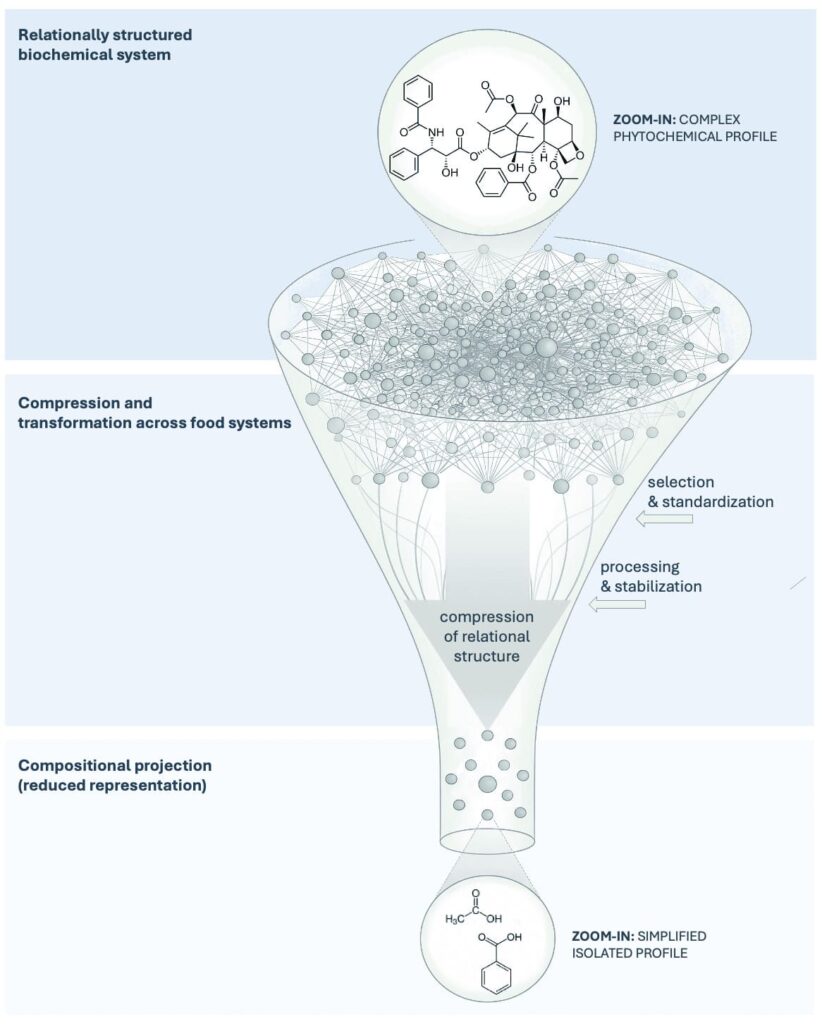
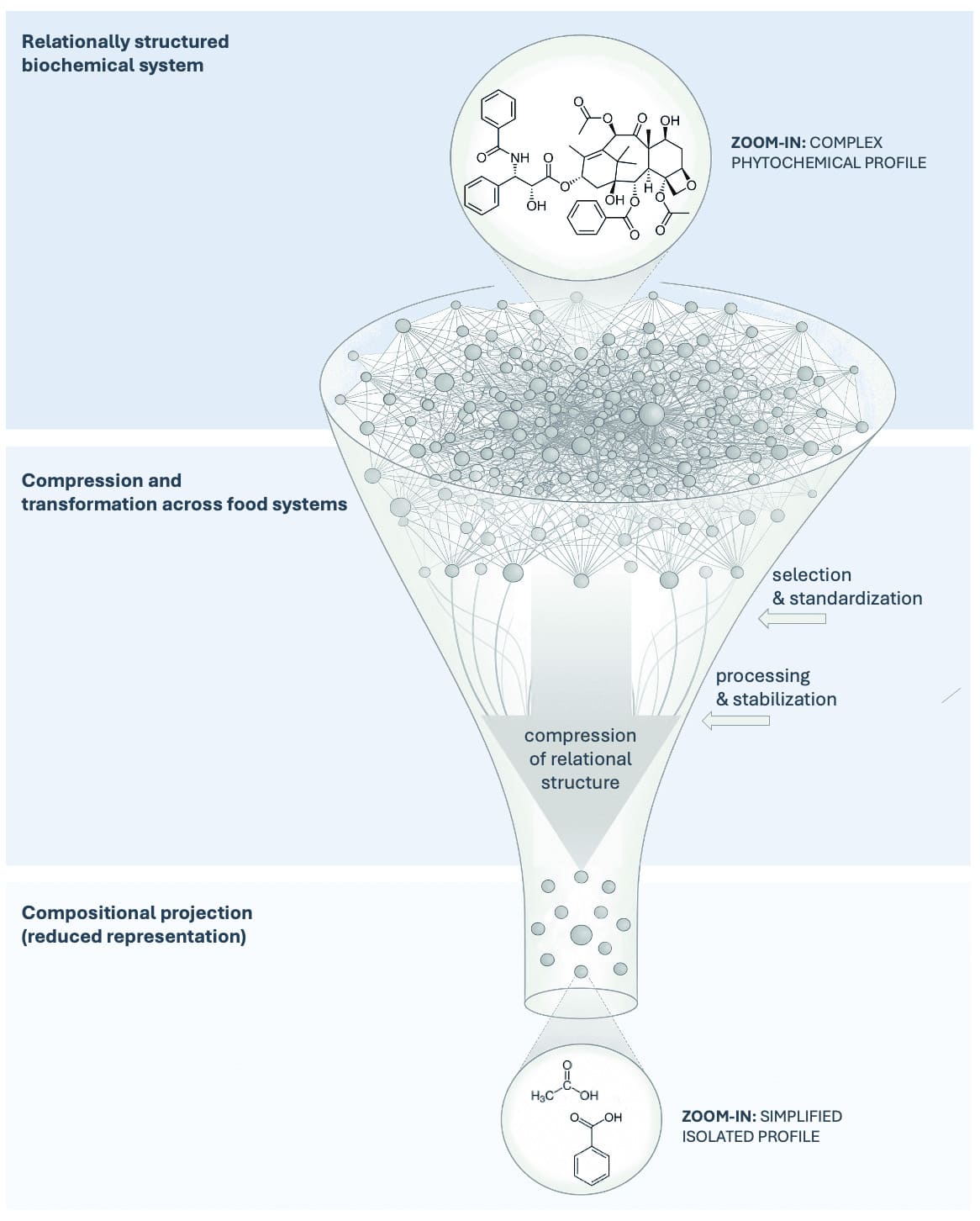
However, complex biological matrices may differ not only in what they contain, but also in how their components are organised. Components occur as part of structured combinations shaped by cultivation, environment, processing, storage, microbial transformation and biological use. In such systems, relationships between components may carry information that is not fully captured by isolated measurements or average concentrations.
This ongoing research direction examines whether food and biological systems that appear compositionally similar may nevertheless differ at the level of internal organisation. The question is particularly relevant for plant-derived foods, botanical preparations, fermented matrices, processed products and other complex biological materials, where biological and technological conditions can shape the arrangement of components without necessarily producing large changes in conventional compositional descriptors.
The question has become increasingly relevant as food and biological systems are being standardised, processed and compared at unprecedented analytical resolution. Modern specifications can establish whether selected compounds, nutrients or marker profiles fall within defined ranges. They are less suited to asking whether a matrix as a system has retained, lost or reorganised higher-order relationships. This is particularly important in domains where production conditions, processing routes or biological transformation may alter system properties without producing obvious compositional discontinuities.
The project does not assume that organisational differences are inherently functional. Its first aim is more limited: to clarify whether such differences can be made observable, compared across contexts and later tested for biological, technological or quality-related relevance. This distinction is essential. A difference in organisation would not, by itself, demonstrate a difference in biological effect. It would define an additional level of comparison that can then be evaluated empirically.
Composition therefore, remains indispensable. No serious account of food quality, phytochemical characterisation or biological exposure can dispense with analytical composition. Yet compositional equivalence may not always capture all system-level properties that distinguish one matrix from another. If organisational features prove measurable and reproducible, they could provide an additional level of comparison for production systems, processing conditions, botanical preparations and complex food matrices.
The broader relevance lies in connecting analytical chemistry with systems-level questions. How do production and processing affect not only what is present, but how a matrix is organised? When are conventional compositional specifications sufficient, and when might additional descriptors be needed? Could unresolved variability in quality, reproducibility or biological response partly reflect differences that current frameworks do not measure?
These questions are relevant beyond a single discipline. In food systems, they may help refine how production and processing are compared. In phytochemistry, they may support a more system-oriented view of botanical materials and preparations. In quality science, they raise the possibility that reproducibility may depend not only on matching compositional targets, but also on preserving relevant organisational features. In exposure research, they invite a closer examination of how repeated encounters with complex mixtures are structured over time.
The work is currently in development and is not presented as a completed study. Its purpose is to define an emerging research question at the interface of food systems, phytochemistry, systems biology and applied quality science, without presenting final results. The central issue is deliberately precise: whether organisation can become an additional level of scientific comparison alongside composition, and under which conditions such a level would add explanatory or practical value.