
A Mediterranean Shrub Long Linked to Fire May Also Be Shaped by Runoff
Experiments with Cistus albidus L. suggest that water carrying gravel and sediment can help unlock hard-coated seeds, challenging a fire-centred view of Mediterranean shrub regeneration.
Note:
This Research Commentary reflects on findings previously published in Ecological Processes. It presents an interpretive perspective and does not report new experimental data.
Author disclosure: Daniel Raus de Baviera is the first and corresponding author of the study discussed in this commentary.
Abstract
In Cistus albidus L., a widespread western Mediterranean species, experimental work shows that sediment-laden runoff can produce germination in the same range as heat-related treatments. The result does not overturn the role of fire. Instead, it suggests that fire and runoff may act as complementary ecological filters, each opening the hard seed coat under different environmental circumstances.
That distinction matters because germination is only the first threshold in regeneration. A seed may be released from dormancy by heat, abrasion or prolonged hydration, but a seedling must then survive the season into which it emerges. In this study, summer emergence was followed by near-complete mortality, whereas autumn cohorts survived well. The story of C. albidus is therefore not simply a story about how seeds open. It is a story about timing.
The field observation behind the question
A shrub commonly interpreted through the ecology of fire may also depend on water-driven abrasion to release its seeds from dormancy. In a recent study of Cistus albidus, a western Mediterranean shrub, a simulation combining angular gravel and water produced 78.4% final germination—within the range observed after dry heat, simulated wildfire and manual scarification (Raus de Baviera et al., 2026). This result does not diminish the role of fire. It broadens the ecological frame: heat and sediment-laden runoff may provide different pathways through the first threshold of recruitment.
That distinction matters because germination is not equivalent to regeneration. A seed may become permeable after heat, abrasion or prolonged hydration, yet the resulting seedling must still survive the conditions into which it emerges. In a complementary establishment trial using heat-treated seeds, mean survival after 60 days was only 4.8% in summer, compared with 90.9% in autumn. Because the two seasonal trials did not manipulate temperature and moisture factorially, they do not identify heat as the sole cause of mortality. They do, however, reveal a strong post-emergence bottleneck. The story of C. albidus is therefore not simply about how seeds open. It is about whether dormancy release occurs at a time when establishment remains possible.
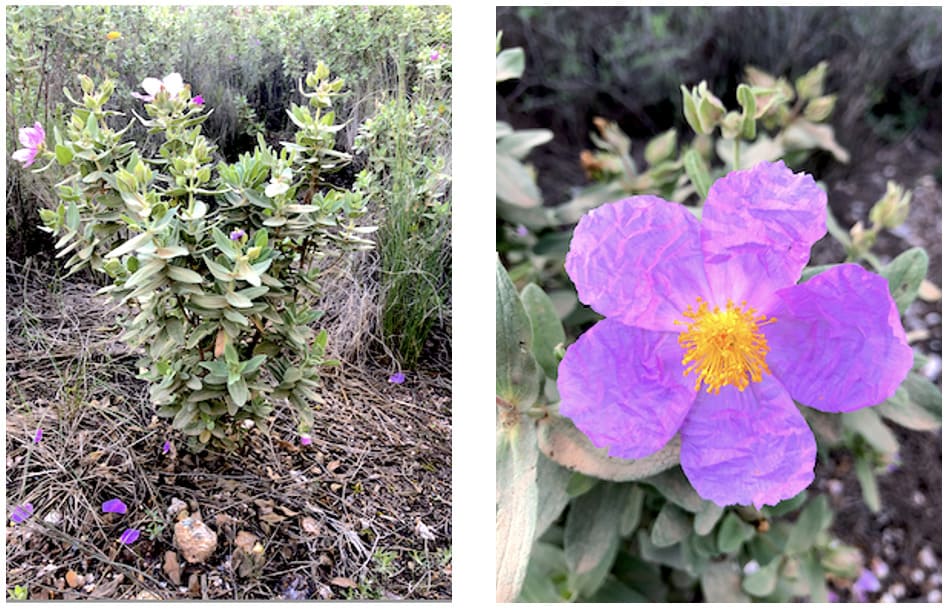
I began to notice this during repeated visits to dry slopes in south-eastern Spain. The distribution and persistence of C. albidus did not always fit the familiar post-fire narrative. During prolonged dry periods, individuals on exposed ridges and open slopes appeared especially vulnerable, whereas plants rooted near ephemeral gullies, sheltered slopes and runoff pathways often persisted where water, sediment and temporary moisture converged after intense rainfall. These observations did not establish a mechanism, but they changed the question: if fire can break dormancy in Cistus, could sediment-laden runoff do something similar?
The landscape made that question difficult to ignore. In semi-arid Mediterranean terrain, rainfall often arrives after long dry periods as short, intense events capable of mobilising gravel, fine sediment and organic matter. Seeds lying on or near the surface may be moved, buried, struck, abraded and hydrated within the same episode. Mediterranean catchments can deliver substantial pulses of suspended sediment during such events (López-Tarazón & Estrany, 2017). For a species with small, hard and irregularly polyhedral seeds, runoff seemed potentially more than a dispersal process. It might also contribute to dormancy release.
Those field observations changed how our research team framed the study. Rather than asking only whether C. albidus is fire-adapted, we asked whether a fire-centred account of its regeneration was sufficient. The experiments support a more nuanced interpretation: the species responds strongly to heat, but its regeneration ecology may also include a hydrological pathway that has received less attention.
A familiar fire story
Mediterranean shrublands have long been interpreted through disturbance. Hot, dry summers, recurrent wildfire, episodic drought and irregular rainfall shape plant communities and favour traits that delay, protect or synchronise regeneration. In the Cistaceae, hard-coated seeds are commonly associated with physical dormancy: the embryo remains viable, but water cannot readily enter until the seed coat is disrupted. Heat associated with fire is one of the best-established environmental cues capable of releasing this dormancy (Moreira & Pausas, 2012; Luna et al., 2023).
Cistus albidus fits this ecological tradition. The species is an obligate seeder: after major disturbance, population recovery depends primarily on seeds rather than resprouting. Its thick, water-impermeable seed coat can protect the embryo during dry periods and storage, but it also creates a barrier that must be crossed before germination. In the conventional account, fire supplies the opening cue while also removing vegetation and creating a post-fire recruitment window.
Yet this account leaves several observations unresolved. It does not fully explain the presence of substantial C. albidus populations in sites without recent fire, particularly where runoff concentrates seeds and moisture. Nor does it establish that heat is unique as an ecologically relevant dormancy-breaking agent. The important question is therefore not whether fire works—it clearly does—but whether it is the only disturbance process capable of making the seed coat permeable.
Putting runoff to the test
Seeds collected from six mother plants in Valle y Carrascoy Regional Park in Murcia, Spain, were exposed to several candidate dormancy-breaking treatments. Dry heat provided a controlled thermal pulse. A field-scale wildfire simulation exposed shallow-buried seeds to combustion conditions. Manual scarification with sandpaper served as a mechanical reference. A runoff simulation tumbled seeds with angular gravel and water to reproduce abrasion during sediment-laden flow. Seeds retained on the mother plants for approximately one year were also examined to determine whether natural ageing substantially relaxed dormancy.
The key result was not that heat worked; that was expected. Final germination reached 80.7% after dry heat, 72.6% after simulated wildfire and 73.9% after manual scarification. No significant difference in final germination was detected among these replicated fresh-seed treatments. The runoff simulation produced 78.4% germination, placing its descriptive estimate within the same numerical range.
That comparison requires an important qualification. Seeds from all six mother plants had to be pooled during the runoff procedure and could not be reassigned after tumbling and sieving. The treatment therefore consisted of a single composite batch. It could not provide an estimate of within-treatment variance and was excluded from inferential comparisons. The 78.4% value is consequently evidence that the simulated process can work, not proof that natural runoff is equivalent to fire or that its effect is consistent among maternal lineages.
The wildfire simulation added a second distinction. Seeds exposed to simulated wildfire reached 50% germination in approximately half the time required by dry-heat-treated seeds, yet their final germination was not higher. Fire altered the pace of germination more clearly than its eventual level. In ecological terms, faster is advantageous only when the conditions following emergence allow seedlings to survive.
Runoff differs from fire in another important respect. It may abrade the seed coat while simultaneously hydrating, transporting and depositing the seed. Water-mediated seed movement can influence both the timing and spatial pattern of recruitment by redistributing seeds among microsites (Nilsson et al., 2010). Runoff is therefore potentially both disturbance and delivery: it may contribute to opening the coat while moving the seed towards a location where moisture persists longer than on an exposed slope.
Germination was not the whole story
The strongest contrast appeared after germination. In the complementary establishment trials, heat-treated seeds were sown in summer and autumn while soil moisture was maintained at field capacity. Cotyledon emergence was high in both periods—79.4% in summer and 82.3% in autumn—showing that the seeds remained capable of producing seedlings. Survival nevertheless diverged sharply. Most summer seedlings died within two to five days after emergence; only 4.8% remained alive after 60 days and 1.7% developed true leaves. In autumn, mean survival after 60 days reached 90.9% (Raus de Baviera et al., 2026).
The experiment did not isolate temperature from every other seasonal difference, and it included neither an untreated control nor runoff-scarified seeds. It should therefore be interpreted as evidence of a seasonal establishment bottleneck, not as a factorial demonstration that temperature alone caused mortality or that runoff-treated seeds would perform differently. Even within those limits, the biological implication is clear: germination capacity by itself does not predict recruitment success.
This leads to a testable ecological hypothesis. In Mediterranean catchments, sediment-laden runoff generally occurs during rainfall events, when abrasion, water exposure and temporarily elevated soil moisture can coincide. Seeds made permeable during such events may be more likely to encounter favourable establishment conditions than seeds released from dormancy by heat during a dry-season fire. The present experiment did not compare these pathways under natural conditions, so this proposed advantage of runoff remains a hypothesis rather than a demonstrated outcome.
The hard seed coat is therefore better understood not as a lock opened by a single key, but as a filter responsive to different environmental histories. Heat, abrasion and hydration influence when water can reach the embryo, while seed age and mother-plant origin modulate the response. Recruitment begins only when that physiological transition coincides with a demographic opportunity.
Seeds that wait, and seeds that differ
One-year-old seeds added a further temporal dimension. Seeds retained on the mother plants for approximately one year remained substantially viable, with mean viability declining from 85.2% in fresh seeds to 75.8% in the older cohort. Yet final germination after 12 hours of hydration was only 4.3%. Extending hydration to 24 hours increased germination to 16.4%, but most seeds remained dormant. Ageing alone therefore did not remove the water-impermeable barrier.
Such persistence may be adaptive in an unpredictable environment. If an entire seed cohort became permeable after a fixed period, one poorly timed rainfall event could expose all of it to subsequent drought. Variation in dormancy and hydration behaviour may instead spread risk across time, preventing every seed from responding to the same environmental episode (Gianella et al., 2021). Some seeds respond rapidly to strong physical cues, some require longer hydration, and others remain dormant. This should be regarded as a plausible bet-hedging interpretation, not as a strategy directly tested by the experiment. Mother-plant-level differences also shaped the data. Initial seed mass showed a weak positive trend with germination in the pooled data set (rs = .360, p = .051), but the association was weak and nonsignificant when treatments were analysed separately. The pooled pattern therefore appears to reflect differences among mother plants rather than a general treatment-independent effect of seed mass. This does not establish a particular maternal mechanism, but it underscores an important point: disturbance cues act on seeds with different developmental histories, provisioning and coat properties.
Why climate change makes timing central
Mediterranean disturbance regimes are changing. Increasing drought, altered rainfall patterns and more severe fire conditions may disrupt the sequence linking disturbance to recovery (Intergovernmental Panel on Climate Change [IPCC], 2022). A fire may be followed by delayed rainfall; an intense rain event may abrade and hydrate seeds only to be followed by renewed drought. Post-fire research in Mediterranean shrublands likewise shows that rainfall timing can strongly influence emergence and recruitment, although responses differ among species (Moreno et al., 2011).
This makes C. albidus a useful model for regeneration under environmental mismatch. The species can respond to more than one dormancy-breaking pathway, but physiological flexibility has demographic value only if at least one pathway leads into conditions that permit establishment. Disturbance creates an opportunity; it does not guarantee that the opportunity remains open. For restoration ecology, the practical implication is not that runoff should replace fire as a management model. It is that hydrological context deserves explicit attention. Fire-based interventions may not ensure regeneration if emergence occurs in an unsuitable seasonal window. Conversely, ephemeral channels, lower slopes and depositional microsites may offer recruitment opportunities even in the absence of recent fire. These possibilities warrant field testing before they are translated into prescriptive management.
What remains uncertain
The study has clear limits. Seeds came from a single semi-arid population in south-eastern Spain. The runoff simulation was represented by one composite batch and could not be analysed inferentially. The establishment trials used only heat-treated seeds, lacked an untreated control and did not manipulate dormancy-breaking pathway, temperature and soil moisture factorially. Field observations from runoff-influenced microsites provided ecological context but did not demonstrate that natural sediment movement scarified the seeds that later established there.
These limitations should determine the next phase of research. Replicated runoff experiments are needed, with mother-plant lineages kept separate and sediment size, flow intensity and exposure duration varied systematically. Comparative studies across populations and bioclimatic gradients could reveal whether responsiveness to both thermal and abrasive cues is a species-wide property or a regional pattern. Establishment experiments should then cross dormancy-breaking treatment with temperature and soil-moisture regimes to test whether different routes into germination have different consequences for seedling performance.
The limits do not erase the conceptual shift; they define its boundary. The study shows that a gravel–water simulation can disrupt the hard seed coat of C. albidus and produce substantial germination. Whether natural runoff operates with comparable effectiveness and consistency remains unresolved. That distinction is precisely why the hydrological pathway is best presented as an experimentally supported ecological hypothesis rather than an established field mechanism. Although C. albidus has a documented history of traditional medicinal use (Raus de Baviera et al., 2023), the present study did not examine phytochemistry or biological activity. It nevertheless raises a separate question relevant to medicinal-plant research: could disturbance history, hydrological position and seasonal establishment leave detectable signatures in the plant’s later functional phenotype? Seasonal progression is already known to exert a strong influence on growth and secondary metabolism under controlled cultivation (Raus de Baviera, Losada-Echeberría, et al., 2026), but the contribution of earlier ecological history remains to be tested.
A different way to read the landscape
The familiar image of Mediterranean regeneration is a blackened slope after fire, with dormant seeds waiting beneath the ash. That image remains valid, but it is incomplete. Another scene should be added: a dry channel after intense rain, with water and gravel briefly moving through the landscape, abrading seeds and depositing them where moisture may persist.
Seen from this perspective, Cistus albidus is not defined by one disturbance cue. Fire may open dormancy quickly; runoff may open it while carrying water; autumn may permit what summer prevents. Recruitment depends on the temporal coupling of disturbance, hydration and establishment across a chain of thresholds.
This study illustrates environmental organisation in a concrete form. Recruitment is not determined by a single cue. No single factor is sufficient to explain successful recruitment. Regeneration depends on how disturbance, hydration, transport, microclimate and post-emergence conditions become aligned across time and space.
For Mediterranean ecology, this is the larger lesson. As climate change reshapes fire seasons, rainfall patterns and drought intensity, regeneration will depend increasingly on whether ecological cues remain synchronised with the conditions required for survival. C. albidus reminds us that disturbance does not guarantee renewal. It only creates a possibility.
References
Gianella, M., Bradford, K. J., & Guzzon, F. (2021). Ecological, (epi)genetic and physiological aspects of bet-hedging in angiosperms. Plant Reproduction, 34, 21–36. https://doi.org/10.1007/s00497-020-00402-z
Intergovernmental Panel on Climate Change. (2022). Climate change 2022: Impacts, adaptation and vulnerability. Cambridge University Press. https://doi.org/10.1017/9781009325844
López-Tarazón, J. A., & Estrany, J. (2017). Exploring suspended sediment delivery dynamics of two Mediterranean nested catchments. Hydrological Processes, 31, 698–715. https://doi.org/10.1002/hyp.11069
Luna, B., Piñas-Bonilla, P., Zavala, G., & Pérez, B. (2023). Timing of fire during summer determines seed germination in Mediterranean Cistaceae. Fire Ecology, 19, Article 52. https://doi.org/10.1186/s42408-023-00210-6
Moreira, B., & Pausas, J. G. (2012). Tanned or burned: The role of fire in shaping physical seed dormancy. PLOS ONE, 7(12), e51523. https://doi.org/10.1371/journal.pone.0051523
Moreno, J. M., Zuazua, E., Pérez, B., Luna, B., Velasco, A., & Resco de Dios, V. (2011). Rainfall patterns after fire differentially affect the recruitment of three Mediterranean shrubs. Biogeosciences, 8, 3721–3732. https://doi.org/10.5194/bg-8-3721-2011
Nilsson, C., Brown, R. L., Jansson, R., & Merritt, D. M. (2010). The role of hydrochory in structuring riparian and wetland vegetation. Biological Reviews, 85, 837–858. https://doi.org/10.1111/j.1469-185X.2010.00129.x
Raus de Baviera, D., Losada-Echeberría, M., Álvarez-Martínez, F.-J., Borrás-Rocher, F., Ruiz Canales, A., Micol, V., & Barrajón-Catalán, E. (2026). Phytochemical and growth patterns in Cistus albidus L.: Seasonal impacts of inoculation and fertilization. Journal of Plant Growth Regulation, 45, 3281–3307. https://doi.org/10.1007/s00344-026-12083-5
Raus de Baviera, D., Ruiz-Canales, A., & Barrajón-Catalán, E. (2023). Cistus albidus L.—Review of a traditional Mediterranean medicinal plant with pharmacological potential. Plants, 12(16), 2988. https://doi.org/10.3390/plants12162988
Raus de Baviera, D., Ruiz-Canales, A., & Barrajón-Catalán, E. (2026). Fire and runoff as complementary ecological filters shaping dormancy release and recruitment in Cistus albidus L. Ecological Processes, 15, Article 63. https://doi.org/10.1186/s13717-026-00720-6
Editorial Disclosure
Daniel Artur Raus is Founder and Scientific Editor of Interstitium. He took no part in the editorial assessment or publication decision for this contribution. The manuscript was handled and approved by Sandra Sáez-Morales, Associate Editor.
Contributions
Daniel Raus de Baviera: Conceptualisation, Funding acquisition, Resources, Investigation, Writing original draft.
Competing Interest
The author declares that he has no known competing financial interests or personal relationships that could have appeared to influence the work reported in this paper.
Publisher’s Note
Interstitium remains neutral with regard to jurisdictional claims in published maps and institutional affiliations.