Research Commentary
Examines published research, clarifies its implications and identifies unresolved questions, limitations or overlooked connections.
The significance of a scientific study is not always exhausted by the conclusions stated in the original publication. Findings may raise broader conceptual questions, challenge established interpretations or reveal connections that become visible only when the research is considered from another disciplinary or methodological perspective.
Research Commentaries provide a space for this form of focused examination. They begin with clearly identifiable published research and develop an evidence-based interpretation of its wider significance. Their purpose is not simply to explain what a study found, but to investigate what those findings may mean, where their interpretation remains uncertain and which new questions they make possible.
Purpose
A Research Commentary may focus on a single publication, a connected group of studies or a specific line of research. It places the research within a wider scientific context and examines implications that may not have been fully developed in the original work.
The central contribution lies in the analysis offered by the commentary. This may involve clarifying the conceptual importance of a result, identifying assumptions that influence its interpretation, examining the relationship between findings and methods or connecting the research to questions arising in another field.
Research Commentaries are particularly suited to findings whose importance extends beyond their immediate experimental setting. A study of seed germination, for example, may raise wider questions about ecological adaptation, restoration practices or the interaction between environmental processes. Research on plant extracts may reveal unresolved relationships between chemical composition, preparation and biological activity. In each case, the commentary moves from a specific evidential basis towards a broader—but proportionate—scientific interpretation.
What We Publish
Research Commentaries may include:
- examinations of the conceptual, methodological or practical implications of published research;
- interpretations of findings that have received limited attention;
- connections between a specific study and a wider scientific problem;
- critical discussion of limitations, uncertainties or unresolved questions;
- consideration of how methods or experimental conditions shape interpretation;
- comparisons between closely related findings or competing explanations;
- proposals for new hypotheses, experiments or directions for investigation.
A commentary may be critical, supportive or exploratory. Whatever its orientation, it should represent the original research accurately and distinguish clearly between reported findings, the authors’ conclusions and the interpretation developed in the commentary.
Limitations should be discussed in proportion to their actual relevance. The identification of uncertainty should help clarify what can and cannot be concluded from the research, rather than being used to dismiss findings merely because they are incomplete.
Commenting on the Author’s Own Research
Authors may submit commentaries on research in which they were directly involved. Such contributions can provide valuable insight into the questions, observations or wider implications that emerged from a study but could not be fully examined within the original research article.
This relationship must be stated transparently in the published commentary. The contribution should also possess clear analytical value beyond the presentation or promotion of the underlying publication. It should acknowledge relevant limitations, avoid overstating the significance of the findings and remain understandable as a scholarly contribution in its own right.
What a Research Commentary Is Not
A Research Commentary is not a repetition of a published abstract, a general summary of recent research or a promotional account of the author’s own work. It is also not a substitute for the original publication, a conventional literature review or a report of new experimental findings.
Although commentaries may make research accessible to readers from different fields, accessibility alone is not their defining purpose. A contribution should offer an identifiable interpretative advance: a clearer understanding of why the research matters, what remains unresolved or how it may alter the questions being asked.
Critical commentaries must engage with evidence, methods or interpretation rather than with individuals. Disagreement should be specific, proportionate and directed towards advancing scientific understanding.
Scholarly and Editorial Status
Research Commentaries are assessed for the accuracy with which they represent the underlying research, the depth and originality of their analysis, the relevance of the connections they develop and the proportionality of their conclusions.
The publication or body of research under discussion must be clearly identified and referenced. Additional scholarly literature should be used where necessary to substantiate the commentary’s interpretation and place it within an appropriate scientific context.
Contributions undergo editorial assessment and, where necessary, revision before publication. They are scholarly publications, but they are not externally peer-reviewed research articles. Their article type, editorial status and any direct relationship between the authors and the research discussed are stated transparently in the published article.
For Authors
Research Commentaries typically range from 1,500 to 3,500 words, although length may vary according to the research examined and the scope of the analysis. Manuscripts should identify their principal publication or evidential starting point, formulate a clear interpretative focus and explain why the issues raised are scientifically significant.
Detailed requirements concerning manuscript structure, references, figures, disclosures and editorial assessment are provided in the Author Guidelines.
Research Commentaries
Explore Research Commentaries published by Interstitium.
-
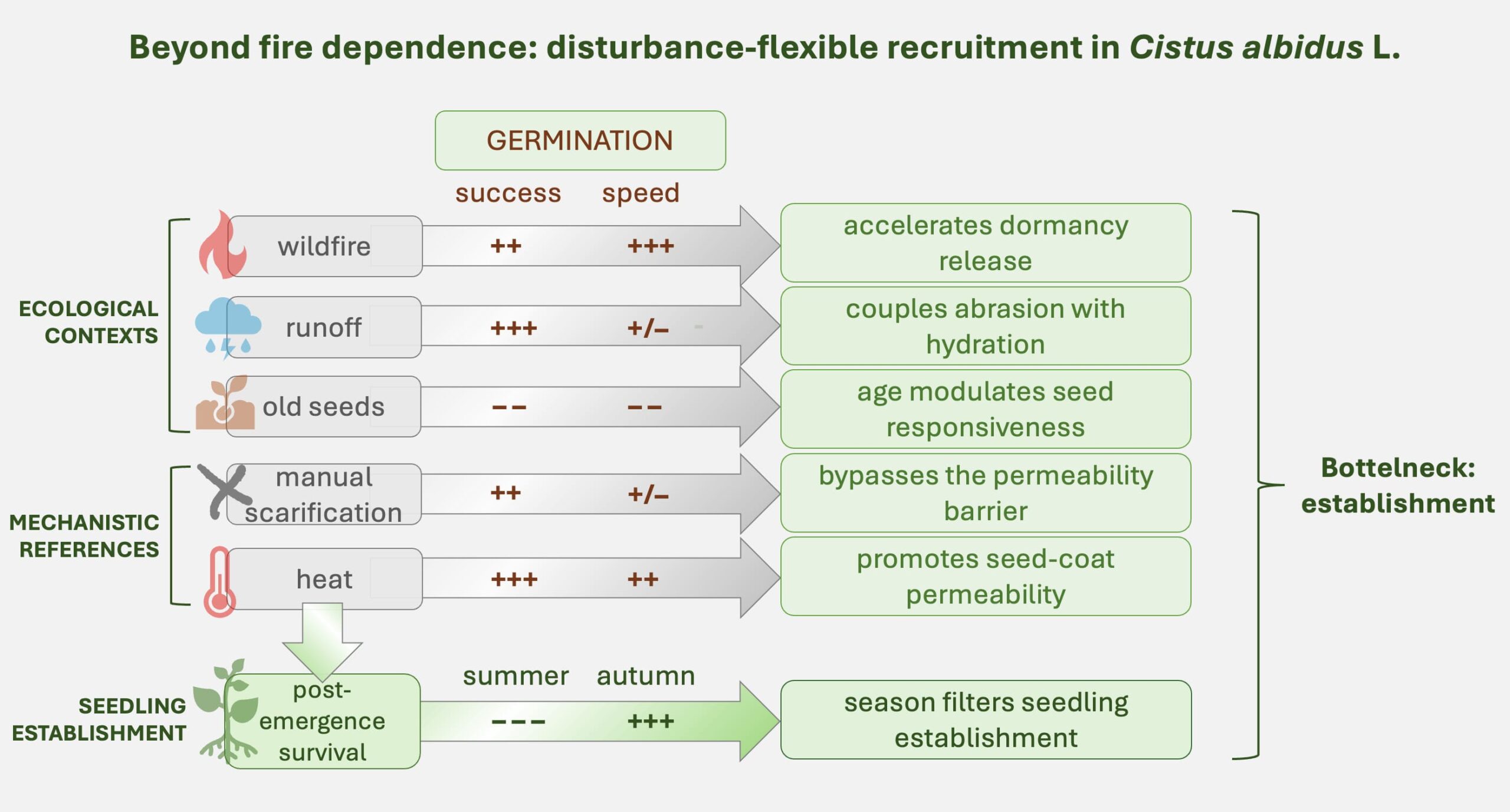
Experiments with Cistus albidus L. suggest that water carrying gravel and sediment can help unlock hard-coated seeds, challenging a fire-centred view of Mediterranean shrub regeneration. Note: This Research Commentary reflects on findings previously published in Ecological Processes. It presents an interpretive perspective and does not report new experimental data. Author disclosure: Daniel Raus de Baviera…