Scientific Essay
When May Medicine Treat Distinguishable States as Equivalent?
Interstitium · Volume 1 (2026) · Article 2
Published 24 August 2026
Systems Biology & Organisational Biology
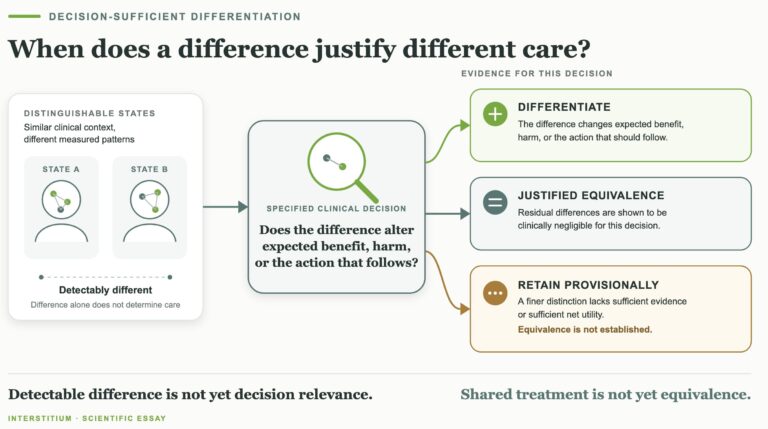
Medicine can distinguish ever finer biological and clinical states. Yet the decisive question is not simply what medicine can distinguish, but what it must distinguish to make sound decisions. This Scientific Essay develops a framework for determining when treating distinguishable states as equivalent is sufficient for the decision at hand—and when doing so conceals differences that alter benefit, harm, or access to care. Drawing on examples from precision oncology, pharmacogenomics, diagnostic testing, non-inferiority trials, and biosimilar regulation, it synthesises published evidence and reports no new empirical data.