Scientific Essay
Develops an evidence-based argument that connects disciplines, questions established assumptions and opens new directions for scientific thought.
Scientific knowledge is often organised within disciplinary, methodological and conceptual boundaries. These boundaries make focused research possible, but they can also obscure relationships that become visible only when findings from different fields are considered together.
Scientific Essays provide a space for examining such relationships. They develop a clearly identifiable argument grounded in scholarly evidence, while allowing authors to move beyond the structure of a conventional research article or literature review. Their purpose is not merely to summarise what is already known, but to ask what existing knowledge may imply when it is viewed from another disciplinary, conceptual or historical perspective.
Purpose
A Scientific Essay begins with a significant question, tension or overlooked connection. It may reconsider an established assumption, bring previously separate bodies of research into dialogue or propose a new way of interpreting a scientific problem.
The central contribution lies in the argument itself: in how evidence is selected, connected and interpreted. This argument should lead towards a clearer conceptual understanding, a testable proposition or a productive direction for further research.
Scientific Essays are particularly suited to subjects that lie between established fields or levels of explanation—for example, between molecular composition and biological organisation, ecological conditions and pharmacological function, plant–human relationships and cultural development, or experimental findings and their wider conceptual implications.
What We Publish
Scientific Essays may include:
- interdisciplinary interpretations of established research;
- critical examinations of scientific assumptions or categories;
- conceptual connections between previously separate fields;
- historically or epistemologically informed scientific arguments;
- proposals for new questions, models or research perspectives;
- analyses of implications that remain underdeveloped in the existing literature.
Contributions may be exploratory, but they must remain intellectually disciplined. Authors should distinguish clearly between established findings, reasoned interpretation, working hypotheses and more speculative possibilities. The breadth of an argument does not reduce the need for evidential precision.
What a Scientific Essay Is Not
A Scientific Essay is not a conventional literature review, a general opinion piece or a report of original experimental research. It should not use selected evidence merely to support a predetermined position, nor present conjecture as established knowledge.
Although an essay may draw upon the author’s own research, its value must extend beyond the presentation or promotion of that work. The contribution should arise from the wider question it develops and from the relationships it makes visible.
Scholarly and Editorial Status
Scientific Essays are assessed for the clarity and originality of their argument, the quality and relevance of the evidence used, the proportionality of their conclusions and their relevance to the scope of Interstitium.
Contributions undergo editorial assessment and, where necessary, revision before publication. They are scholarly publications, but they are not externally peer-reviewed research articles. Their article type and editorial status are stated transparently on the published article.
For Authors
Scientific Essays typically range from 3,000 to 6,000 words, although length may vary according to the subject and structure of the argument. Manuscripts should present a clear central question or thesis, engage critically with relevant scholarly literature and explain the significance of the proposed interpretation.
Detailed requirements concerning manuscript structure, references, figures, disclosures and editorial assessment are provided in the Author Guidelines.
Scientific Essays
Explore Scientific Essays published by Interstitium.
-
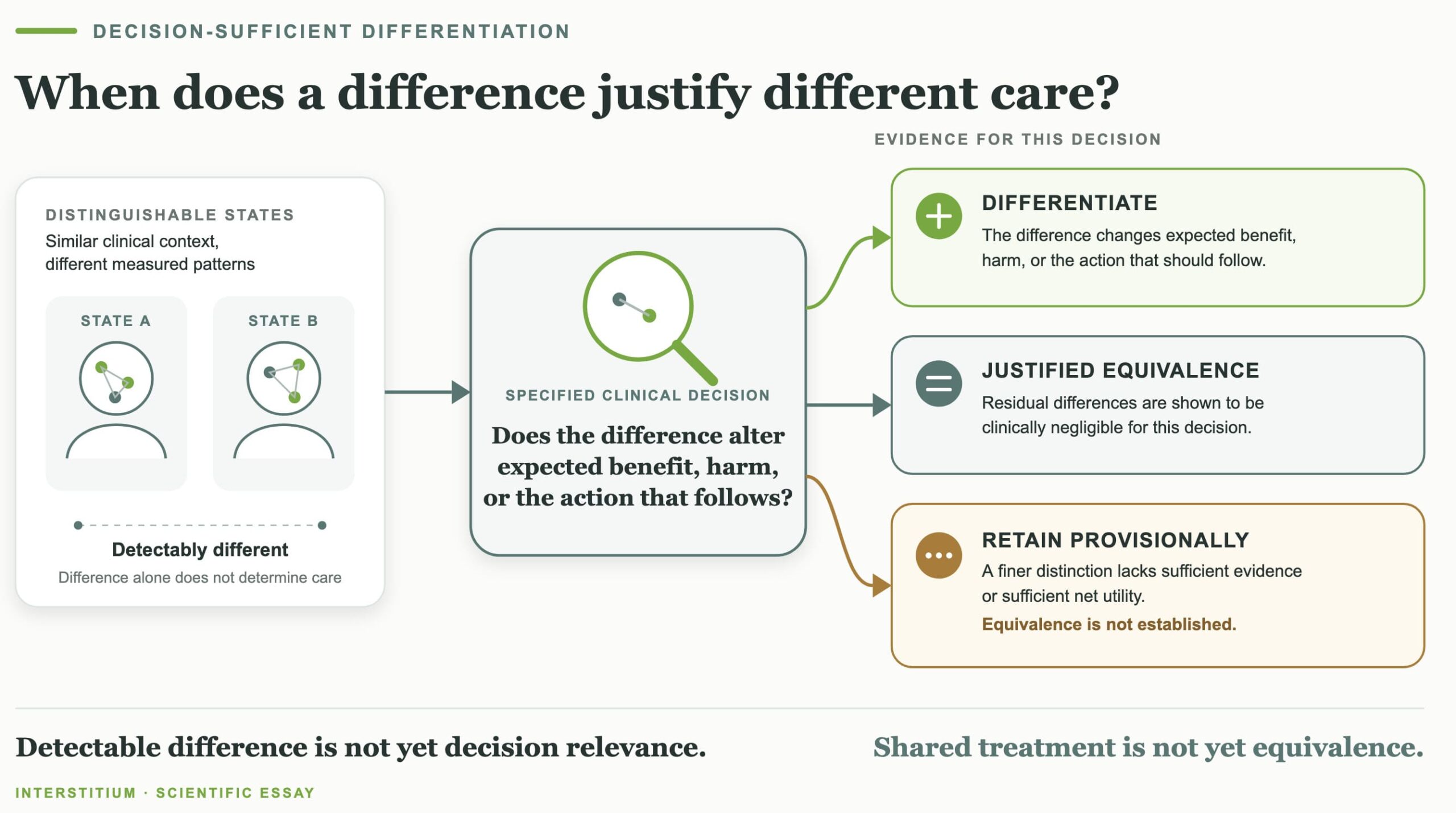
Medicine can distinguish ever finer biological and clinical states. Yet the decisive question is not simply what medicine can distinguish, but what it must distinguish to make sound decisions. This Scientific Essay develops a framework for determining when treating distinguishable states as equivalent is sufficient for the decision at hand—and when doing so conceals differences…