

SCIENTIFIC ESSAY
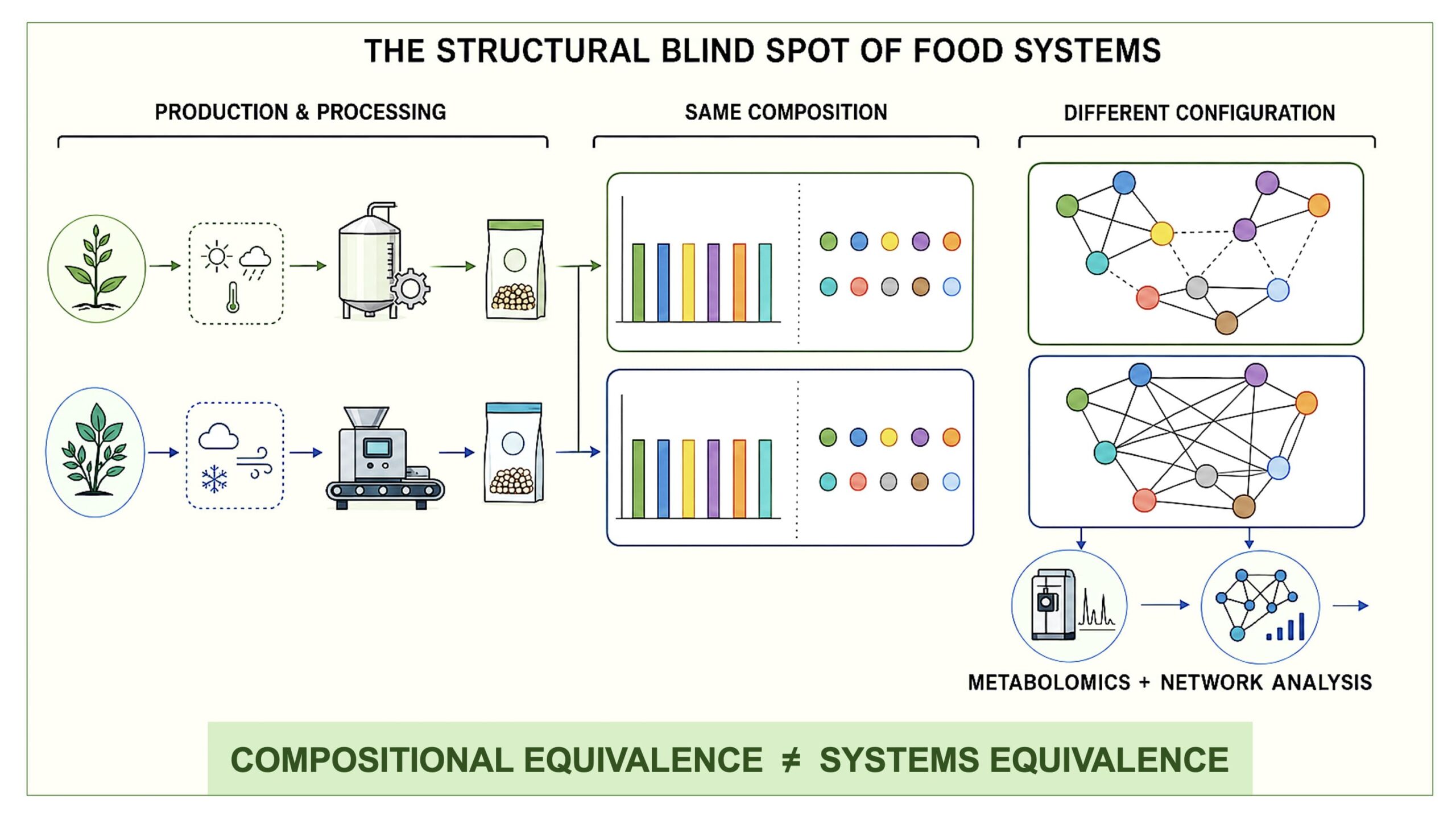
Food systems are commonly compared through concentrations of individual constituents. Yet deliberately matched production or processing populations may also differ in how metabolite abundances co-vary across independent experimental units, even when conventional compositional summaries are similar. We define biochemical configuration as the dependence structure among metabolites estimated within a prespecified sampling frame.
This article distinguishes configuration from the biochemical state of an individual food and outlines how matched sampling, untargeted metabolomics and differential-network methods could make it testable. Configuration should be retained as a food-system comparator only if it can be estimated reproducibly and improves explanation or prediction beyond marginal composition, technical variation and known covariates.