

SCIENTIFIC ESSAY
Toward Decision-Sufficient Differentiation in Precision Medicine
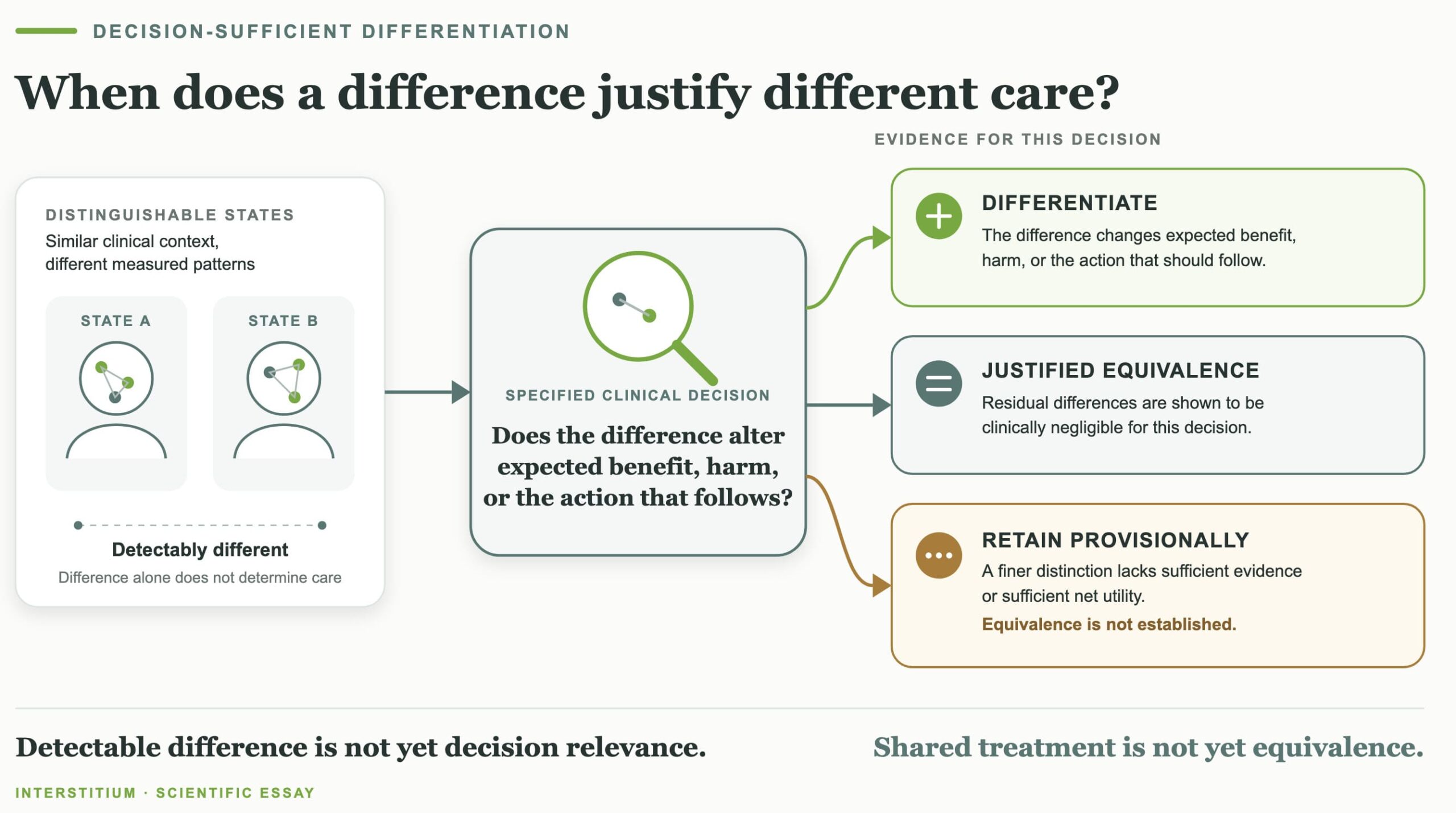
Modern medicine can identify ever finer differences between patients, diseases and treatments. Yet not every detectable difference calls for different care. This Scientific Essay asks when medicine may reasonably treat distinguishable states as equivalent—and when doing so obscures differences that affect expected benefit, risk of harm or access to care.
Drawing on examples from precision oncology, pharmacogenomics, diagnostic testing, non-inferiority trials and biosimilar regulation, the essay develops the idea of decision-sufficient differentiation: medicine should distinguish states only as far as needed to make a sound decision. It synthesises published evidence and does not report new empirical data.
Two states need not be identical to be treated alike; they need only be sufficiently similar for the decision at hand. A genetic difference, for example, may be irrelevant to one treatment but crucial to another. What counts as sufficiently similar therefore depends on the outcome being considered, the strength of the evidence, who is affected and what happens if the judgment is wrong. Equivalence is not an inherent property of two states, but a context-dependent conclusion that requires explicit justification. The central question is not whether medicine can distinguish them, but whether distinguishing them improves the decision that follows.